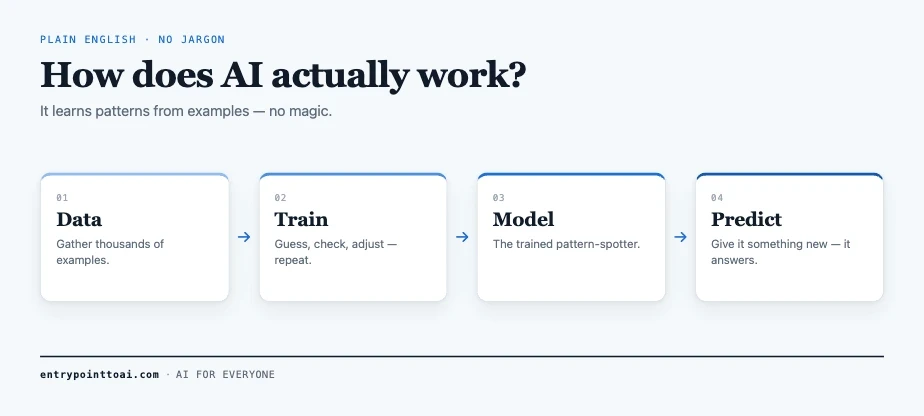
How does AI actually work? Explained without the jargon
AI sounds mysterious, but the core idea is simple: instead of following rules a person wrote, modern AI learns patterns from examples and uses them to make predictions. That’s it. Everything else — chatbots, recommendations, face unlock — is that one idea applied in different ways. Here’s how it actually works, step by step, with no math.
Old software vs AI
Traditional software follows instructions a human typed out: “if the total is over $100, add free shipping.” It only does exactly what it’s told.
AI flips that around. Nobody writes the rules. Instead, you give the system lots of examples and let it figure out the patterns itself. That’s why AI can handle messy, real-world things — recognizing a face, understanding a sentence — that would take millions of hand-written rules to cover.
The four steps behind most AI
Almost every AI tool you’ve used was built with roughly the same recipe:
- Gather examples (data). You collect lots of examples of the task — thousands of emails marked “spam” or “not spam,” say, or millions of sentences.
- Train. The system makes a guess, checks how wrong it was, and adjusts itself a tiny bit. Repeat millions of times. Slowly, its guesses get good.
- Get a model. The trained result is called a model — the finished “pattern-spotter” ready to use.
- Predict. You give the model something new, and it predicts an answer based on the patterns it learned.
That loop — data, train, model, predict — is the engine under the hood of modern AI. Still fuzzy on a step? Our prompt builder for explanations writes you a prompt that asks an AI to go over it at whatever level you’re starting from.
A concrete example: spotting spam
Picture building a spam filter. You can’t write a rule for every junk email — spammers change tactics constantly. So instead:
- You collect thousands of emails already labeled spam or not.
- The system learns which patterns tend to mean spam — certain phrases, links, sender behavior.
- When a new email arrives, it predicts: spam or not, with a confidence score.
Nobody told it “block emails that say ‘free money.’” It learned that pattern from the examples. That’s machine learning in one picture.
So is it actually “thinking”?
This is the part worth being clear about. AI doesn’t think or understand the way you do. It finds statistical patterns and predicts likely outcomes. When a chatbot writes a smart-sounding paragraph, it’s predicting words that tend to fit — not reasoning about the world.
That’s why AI can be brilliant and clueless at once. It might write a flawless essay, then confidently state a fact that’s completely made up. It isn’t lying; it’s predicting plausible text. Knowing this is the difference between using AI well and being misled by it.
Where the AI runs
One last practical piece. Training usually happens once, on powerful computers, before you ever touch the tool. After that:
- Some AI runs on your device, offline — like face unlock or photo sorting on your phone.
- Some runs on company servers you reach over the internet — like ChatGPT, which is too big to run on a phone.
Either way, you’re using the already-trained model. The heavy learning is done; you’re just asking it to predict.
The bottom line
AI works by learning patterns from huge amounts of examples and using them to predict — not by thinking like a person. Data in, training happens, you get a model, the model predicts. Hold onto that simple loop and the whole field stops feeling like magic. It’s powerful pattern-matching, and knowing that helps you trust it where it’s strong and check it where it’s weak.
Keep going: browse more plain-English basics in AI Explained.
Frequently asked questions
How does AI actually work, in simple terms?
Most modern AI works by learning from examples instead of following hand-written rules. You feed it huge amounts of data, it finds patterns, and it uses those patterns to make predictions about new things — like whether an email is spam or what word comes next in a sentence.
Does AI think like a human?
No. AI does not understand or reason the way people do. It spots statistical patterns in data and predicts likely answers. The results can look intelligent, but underneath it is pattern-matching, not human-style thinking.
What is training in AI?
Training is the learning phase. The system is shown many examples and adjusts itself a little each time it guesses wrong, slowly getting better at the task. Once training is done, the finished "model" can be used to make predictions quickly.
Does AI need the internet to work?
Not always. Training usually happens once, on powerful computers. After that, some AI runs on your device offline (like face unlock), while others run on company servers you reach over the internet (like ChatGPT).