AI vs machine learning vs deep learning: what's the difference?
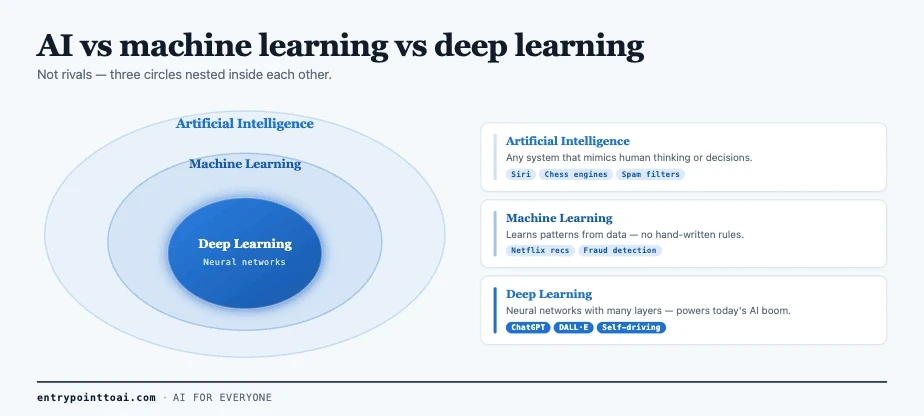
People use “AI,” “machine learning,” and “deep learning” as if they mean the same thing. They don’t — but they’re closely related. The simplest way to picture it: three circles nested inside each other. AI is the biggest circle, machine learning sits inside it, and deep learning sits inside that.
The one-picture version
- Artificial intelligence (AI) — the broad goal: machines doing things that normally need human intelligence.
- Machine learning (ML) — a way to achieve AI: software that learns patterns from examples instead of following rules someone wrote by hand.
- Deep learning — a powerful kind of machine learning that uses layered “neural networks,” and powers most of the AI you hear about today.
So they’re not competitors. They’re a big idea, a method inside it, and a powerful version of that method.
| What it is | Example | |
|---|---|---|
| AI | The broad goal: machines doing intelligent tasks | A chess program, a voice assistant |
| Machine learning | Software that learns patterns from examples | A spam filter, photo tagging |
| Deep learning | Machine learning with layered neural networks | ChatGPT, face recognition |
Artificial intelligence: the big idea
AI is the oldest and widest term — we cover it in depth in what is artificial intelligence. It simply means getting machines to do tasks we associate with human intelligence — understanding language, recognizing images, making decisions, solving problems.
AI doesn’t have to learn anything. Some early AI was just a giant set of hand-written rules: “if the player does X, respond with Y.” That counts as AI, but it’s rigid — it can only handle situations someone thought of in advance. That limit is exactly what the next circle solves.
Machine learning: learning from examples
Machine learning is the breakthrough that made modern AI useful. Instead of writing every rule by hand, you show the software lots of examples and let it work out the patterns itself.
Picture a spam filter. Nobody could write rules for every possible junk email. Instead, you feed it thousands of emails labeled “spam” or “not spam,” and it learns the patterns that tend to mean spam. Show it a brand-new email and it makes a good guess. That’s machine learning: improving from data rather than from hand-written instructions.
Most of the AI tools you use day to day — recommendations, photo tagging, voice assistants — are powered by machine learning. If you want to see this learning-from-examples idea step by step, we walk through it in how AI actually works.
Deep learning: machine learning, scaled up
Deep learning is a specific, powerful type of machine learning. It uses neural networks — software loosely inspired by how brain cells connect — stacked in many layers. The word “deep” just refers to having lots of these layers.
Those extra layers let the system learn extremely complex patterns that simpler methods can’t. That’s why deep learning is behind the most impressive AI: recognizing faces in photos, understanding speech, and the large language models that power chatbots like ChatGPT.
The trade-off is that deep learning needs huge amounts of data and computing power. For years that made it impractical. Today’s cheap, powerful hardware is a big reason AI suddenly feels everywhere.
Why the words get mixed up
The terms get blurred for a simple reason: almost all of today’s headline-grabbing AI is deep learning, which is machine learning, which is AI. So when a news story says “AI,” it usually means a deep learning system — and calling it any of the three isn’t really wrong, just imprecise.
A quick way to keep them straight:
- Say AI when you mean the broad idea or you’re not sure of the details.
- Say machine learning when the point is that it learned from data.
- Say deep learning when it specifically uses big neural networks.
The bottom line
AI, machine learning, and deep learning aren’t three rival technologies — they’re three circles inside each other. AI is the goal, machine learning is how we mostly get there now, and deep learning is the powerful method behind today’s biggest breakthroughs. You don’t need to track the boundaries perfectly. Just remember the nesting, and the buzzwords stop being confusing.
Keep going: browse more plain-English basics in AI Explained.
Frequently asked questions
What's the difference between AI, machine learning, and deep learning?
They are nested, not separate. Artificial intelligence is the big idea: machines doing tasks that need intelligence. Machine learning is one way to build AI — software that learns from examples. Deep learning is a powerful type of machine learning that uses layered "neural networks" and powers most of today's AI.
Is machine learning the same as AI?
Not exactly. Machine learning is a part of AI — the part that learns from data instead of following hand-written rules. AI is the wider goal, and machine learning is the most successful method we currently use to reach it.
What is deep learning in simple terms?
Deep learning is machine learning that uses neural networks with many layers, loosely inspired by how brains process information. The extra layers let it learn very complex patterns, which is why it powers things like image recognition and chatbots such as ChatGPT.
What's the difference between AI and deep learning?
AI is the broad goal — machines doing tasks that need intelligence — while deep learning is one specific technique for getting there: machine learning built on many-layered neural networks. Every deep learning system is AI, but not all AI uses deep learning.
Is deep learning better than machine learning?
Not better, just suited to different problems. Deep learning handles very complex patterns — like recognizing faces or understanding speech — that simpler methods can't. But it needs far more data and computing power, so for many everyday tasks plain machine learning is the more practical choice.