What is a large language model (LLM)? A plain-English explanation
A large language model — usually shortened to LLM — is the kind of AI that powers chatbots like ChatGPT. In plain terms, it’s software that was trained on an enormous amount of text and learned to predict which words come next. Do that well enough, and you get something that can write, answer questions, and hold a conversation. Here’s how it works, without the jargon.
The core trick: predicting the next word
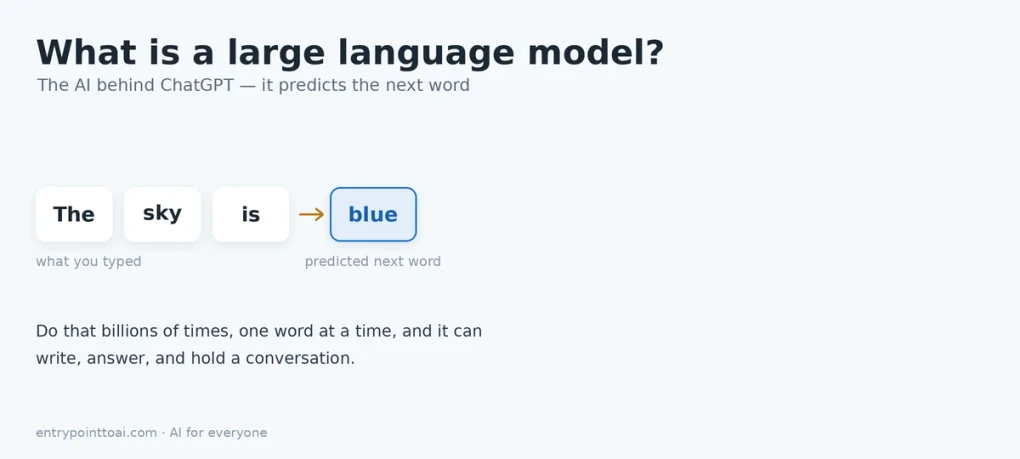
Everything an LLM does comes from one surprisingly simple skill: guessing the next word.
If you read “the sky is…”, your brain already expects “blue.” An LLM works the same way, just at a massive scale. Given everything you typed and everything it has written so far, it predicts the most fitting next word — then the next, then the next — until it has built a full reply.
That sounds too simple to be useful. The surprise of the last few years is that when you do this extremely well, across billions of examples, it starts to look a lot like understanding. The model can explain ideas, draft emails, and answer questions — all by predicting one word at a time.
What “large” actually means
The “large” in large language model points to two things:
- A huge amount of training text. LLMs learn from enormous collections of writing — books, articles, websites. That’s how they pick up grammar, facts, tone, and style.
- Billions of internal settings. During training, the model adjusts billions of tiny values (often called “parameters”) until its word predictions get good. More of these generally means a more capable model.
You don’t interact with any of that directly. You just type, and the trained model does the predicting.
How it learns
Training an LLM happens in one big phase before you ever use it. The model is shown mountains of text with parts hidden, and it practices guessing the missing words. Every wrong guess nudges its internal settings a little. Repeat that billions of times and it gets remarkably good at producing natural language.
You can see the training data in the output if you know where to look. Models punctuate like the books they read, which is why they use so many em dashes.
One important consequence: the model learns from text up to a certain point in time. It doesn’t automatically know about events after its training unless it’s connected to live tools or search. So a plain LLM can be out of date — worth remembering when you ask about recent news.
LLM vs ChatGPT: what’s the difference?
People mix these up, and the difference is easy:
- The LLM is the underlying “brain” that generates text.
- ChatGPT is the app — the friendly chat window — built on top of an LLM.
It’s like the difference between an engine and a car. The LLM is the engine; ChatGPT is the car you actually drive. Other tools — Google Gemini, Claude, and more — are different cars built on their own engines.
Why they get things wrong
Because an LLM predicts likely-sounding text rather than looking facts up, it can be fluent and wrong at the same time. It may invent a name, a statistic, or a source that sounds completely real. This is called a hallucination, and it’s the single most important thing to know about LLMs.
It doesn’t mean they’re useless — it means you stay in charge. Let the model draft, explain, and brainstorm, but check anything that matters before you rely on it.
The bottom line
A large language model is software that learned to predict words by reading a huge amount of text, and that simple skill is enough to power the AI chatbots millions of people now use daily. It’s powerful, fast, and genuinely helpful — and it’s a confident guesser, not a fact checker. Keep both halves of that in mind and you’ll get the best out of it.
New to this? Start with the basics in What is artificial intelligence?
Frequently asked questions
What is a large language model in simple terms?
A large language model (LLM) is the kind of AI behind chatbots like ChatGPT. It was trained on enormous amounts of text and learned to predict which words are likely to come next. By doing that very well, it can write, answer questions, and hold a conversation in plain language.
How does an LLM work?
At its core it predicts the next word, over and over. Given what you typed and what it has written so far, it picks the most fitting next word, then the next, building a full answer. The "large" means it learned from a huge amount of text and has billions of internal settings tuned during training.
Is ChatGPT a large language model?
ChatGPT is an app built on top of large language models. The model is the underlying "brain" that generates the text; ChatGPT is the friendly interface you type into. Other tools like Google Gemini and Claude are also powered by their own LLMs.
Why do large language models make mistakes?
Because they predict likely-sounding text rather than looking up verified facts. That makes them fluent but sometimes confidently wrong — inventing names, numbers, or sources. This is called a "hallucination," and it is why you should check anything important.