What is artificial intelligence? A simple guide for beginners
Artificial intelligence (AI) is software that can do things we normally think require human intelligence — understand language, recognize images, spot patterns, and make suggestions. Instead of following fixed rules someone typed in, it learns from huge numbers of examples. You already use it every day, probably without noticing. Here’s what it really is, in plain English.
AI, in one plain sentence
Most software follows exact instructions: if this, then do that. AI works differently. You show it thousands or millions of examples, and it figures out the patterns on its own — then uses those patterns to handle things it hasn’t seen before.
A simple way to picture it: how you came to recognize a friend’s handwriting. Nobody gave you rules about the loops and the slant. You just saw enough of it that now you’d know it anywhere — even on a word you’ve never seen them write. AI learns in a roughly similar way, from examples rather than rules.
Here’s the difference at a glance:
| Traditional software | Artificial intelligence | |
|---|---|---|
| How it’s made | A person writes the exact rules | It learns patterns from many examples |
| New situations | Only handles what was programmed | Can handle cases it was never shown |
| When it’s wrong | A bug in the rules (does exactly what it was told) | A confident guess that’s off (“hallucination”) |
| Best for | Clear, fixed tasks (math, sorting, calculations) | Messy, pattern-rich tasks (language, images, recommendations) |
Where you already use AI
AI isn’t a far-off, sci-fi thing. It’s quietly running in tools you use right now:
- Email — the spam filter deciding what’s junk.
- Streaming and shopping — the “recommended for you” picks on Netflix, YouTube, or Amazon.
- Phones — face unlock, voice assistants, photo search (“show me beach photos”).
- Maps — predicting traffic and the fastest route.
- Chatbots — tools like ChatGPT that write and answer in plain language.
If you’ve used any of these, you’ve used AI. That’s worth saying plainly, because the word can sound intimidating when the reality is already familiar.
How it learns, without the jargon
You’ll bump into a few buzzwords. You don’t have to memorize them — but here’s what each one actually means, in a line:
- Machine learning is the main idea behind today’s AI: software that improves by learning from data instead of being explicitly programmed.
- Training is the learning phase — feeding the system lots of examples so it can pick up the patterns.
- A model is the result of that training: the finished “pattern-spotter” that you actually use.
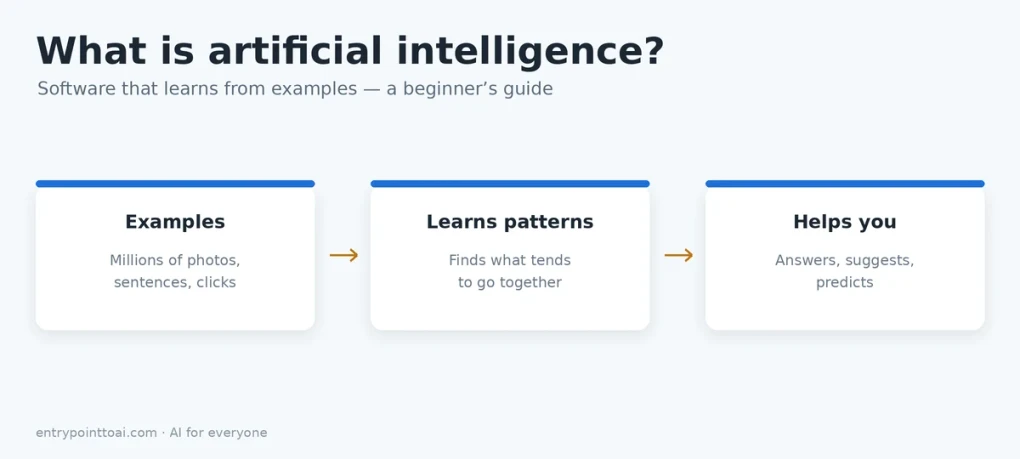
So when people say “an AI model,” they just mean a program that has already learned from a pile of examples and is now ready to answer your questions or make predictions. The whole journey is really just three steps:
What AI is good at — and what it isn’t
AI is genuinely strong at some things and genuinely weak at others. Knowing the line keeps you from being either scared or fooled.
It’s good at:
- Spotting patterns in huge amounts of information faster than any person.
- Handling language — writing, summarizing, translating, answering.
- Doing repetitive tasks tirelessly and instantly.
It struggles with:
- Being reliably correct. It can state wrong things with total confidence. Ask a chatbot about a book that doesn’t exist and it may cheerfully invent the plot, the author, and a publication year — all made up, all delivered in the same sure tone as a real fact. People call these confident mistakes “hallucinations.”
- Real understanding. It predicts likely answers from patterns; it doesn’t truly know things the way you do.
- Judgment and common sense, especially in new or unusual situations.
That’s why the smart way to use AI is as a fast, helpful assistant whose work you still check — not an oracle you obey.
Is AI the same as a robot?
This trips a lot of people up. A robot is a physical machine — arms, wheels, sensors. AI is the software “brain” that can make decisions. Some robots use AI to move and react, but most AI has no body at all. It lives inside apps and websites, completely invisible. The chatbot answering your question and the warehouse robot lifting boxes can both use AI, but the AI itself is just the thinking part.
| Robot | Artificial intelligence | |
|---|---|---|
| What it is | A physical machine — arms, wheels, sensors | Software: the decision-making “brain” |
| Has a body? | Yes | Usually no — it lives inside apps and websites |
| Example | A warehouse robot lifting boxes | A chatbot answering your question |
Why it matters now
AI has existed as an idea for decades, but it became genuinely useful to ordinary people only recently — when tools like ChatGPT made it something you could just talk to. That’s the real shift: you no longer need to be a programmer to use powerful AI. You can type a question in plain language and get real help.
Here’s a recent example from my own week. I was buried in an import project — supplier quotes, customs forms, and invoices scattered across Google Drive with no order to them, more than 100 unread emails, and a calendar with no shape. Instead of losing a whole Saturday to it, I described the mess to Gemini, Google’s AI assistant, in plain words. In under a minute it gave me a full system: a folder structure and naming rules for Drive, Gmail filters and labels to sort new mail on its own, and a weekly time-blocked calendar template. I set it up in forty minutes, not the hours I’d braced for — and now I can find any file or meeting in seconds.
You don’t need to understand how it’s built to benefit from it — the same way you don’t need to understand engines to drive. What helps is knowing the basics: it learns from examples, it’s powerful but fallible, and it’s a tool you direct, not a mind that replaces yours.
The bottom line
Artificial intelligence is software that learns from examples instead of following fixed rules, and you’re already surrounded by it. It’s remarkably capable and confidently imperfect at the same time. Understand that much, and you’re ready to start using AI tools with confidence — and a healthy bit of skepticism.
Next steps: explore more plain-English basics in AI Explained.
Frequently asked questions
What is artificial intelligence in simple terms?
Artificial intelligence (AI) is software that can do tasks we usually think need human intelligence — like understanding language, recognizing photos, or making suggestions. Instead of following fixed instructions, it learns patterns from large amounts of examples and uses them to handle new situations.
What is a simple example of AI?
Everyday examples include the spam filter in your email, the recommendations on Netflix or YouTube, face unlock on your phone, map apps that predict traffic, and chatbots like ChatGPT. You are almost certainly already using AI several times a day.
Is AI the same as a robot?
No. A robot is a physical machine. AI is the software "brain" that can make decisions. Some robots use AI, but most AI has no body at all — it runs invisibly inside apps and websites you already use.
Do I need to be technical to understand AI?
Not at all. You do not need any coding or math to understand what AI is or to use AI tools. Knowing the basics — that it learns from examples and can be wrong — is enough to use it wisely.