What is DeepSeek? And is it safe to use?
DeepSeek is a free AI chatbot made by a Chinese company of the same name. Like ChatGPT or Google Gemini, you type a question in everyday language and it answers — explaining ideas, drafting emails, summarizing documents, helping with homework or code. It became famous almost overnight in January 2025, when it briefly passed ChatGPT as the most-downloaded free app in the world. It’s genuinely capable, and it’s free. It also comes with a privacy catch worth understanding before you type anything personal into it.
The essentials:
- DeepSeek is a free ChatGPT-style chatbot from a Chinese AI company; for everyday questions it holds its own against the big names.
- It made headlines by matching top AI tools while claiming to spend far less money building them.
- Your chats are stored on servers in China — several governments have banned it from official devices — so keep personal details out.
What is DeepSeek?
DeepSeek is an AI company based in Hangzhou, China, and also the name of its chatbot. The company was founded in 2023 by Liang Wenfeng and is funded by High-Flyer, a Chinese hedge fund he co-founded. For its first year and a half, almost nobody outside the AI world had heard of it.
The chatbot works the way you’d expect if you’ve tried ChatGPT. You open the app or go to deepseek.com, type a question, and it writes back in plain language.
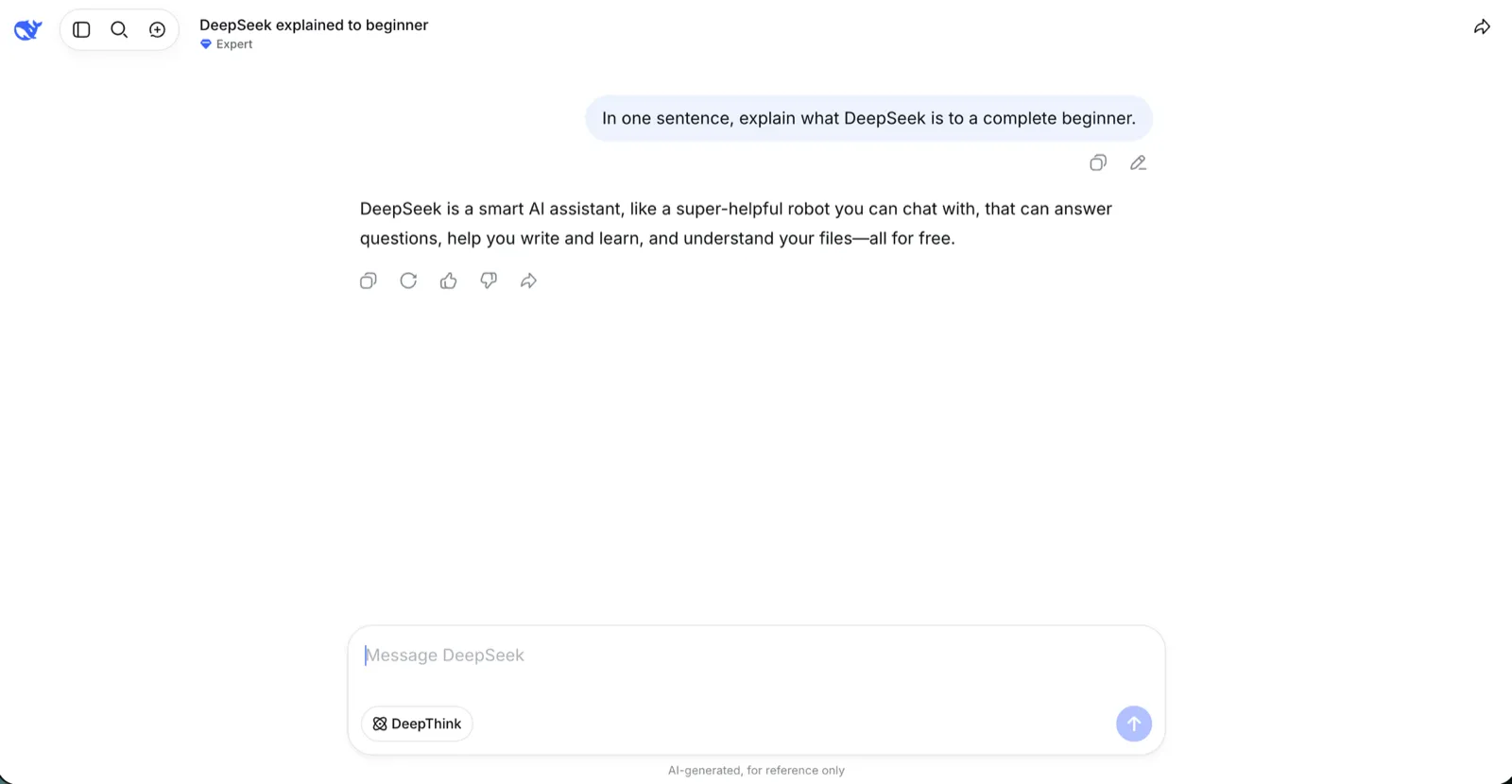 Under the hood it runs on a large language model — software trained on enormous amounts of text until it learned to produce natural writing. (We explain that idea properly in What is a large language model?.) That’s the same technology behind ChatGPT and Gemini, which is why all three feel similar to use.
One thing DeepSeek is known for: a “reasoning” mode called R1 that shows its work. Ask it a tricky question and you can watch it think through the steps before giving you the answer, like a student writing out the math instead of just the result. Newer models followed — the company released its latest flagship, V4, in April 2026 — but you don’t need to track version numbers. You just open the app and chat.
Why did DeepSeek make headlines?
Money. In January 2025, DeepSeek released a model that performed close to the best American AI tools — and said it had trained it for a few million dollars, a tiny fraction of what US companies were spending. The whole industry had assumed that building top-tier AI required billions in computing power. DeepSeek suggested it might not.
The reaction was dramatic. The app shot to #1 on Apple’s App Store. And investors panicked about what cheap AI would mean for the companies selling all that expensive computing power: Nvidia, the biggest of them, lost nearly $600 billion in market value in a single day — at the time, the largest one-day loss for any company in stock market history.
There’s a second reason AI insiders pay attention to DeepSeek: the company gives much of its technology away. Its models are open-weight, meaning anyone can download them and run them on their own computers for free. For you as a chat user that changes nothing, but it’s part of why the company keeps showing up in the news.
How is DeepSeek different from ChatGPT?
For everyday use, the chat experience is similar. The differences show up around the edges.
| DeepSeek | ChatGPT | |
|---|---|---|
| Made by | DeepSeek (China) | OpenAI (US) |
| Price | Free — no paid consumer plan | Free version, plus paid plans with more features |
| Extras | Chat and reasoning; light on features beyond that | Voice mode, image creation, file uploads, app connections |
| Your data lives | On servers in China | On servers mostly in the US |
If you’re weighing the mainstream options first, our ChatGPT vs Gemini comparison covers the two biggest names, and there’s more in our AI tools guides.
Is DeepSeek free?
Yes, completely — and that’s unusual. ChatGPT and Gemini both have free tiers with limits and paid plans above them. DeepSeek just doesn’t charge chat users. The company makes its money from businesses and developers who pay to build products on its technology, so the consumer app has no upsell.
Free is a real advantage. It’s also fair to remember the old internet rule of thumb: when a product costs nothing, look closely at what happens to your data.
Is DeepSeek safe to use?
The app itself works fine — this isn’t a virus or a scam. The concern is privacy, and it’s concrete enough that we’d summarize it in one sentence: what you type into DeepSeek is stored on servers in China.
Why that matters: Chinese law requires companies to cooperate with government intelligence requests, without the court orders or user notifications you’d expect in the US or UK. DeepSeek’s own privacy policy says it stores your personal data in the People’s Republic of China. That combination is why Italy blocked it nationwide over data concerns, and Australia, South Korea, Taiwan, and a growing list of other governments — plus many US states — have banned the app from official devices. Those bans target government phones, not ordinary users, but they tell you how regulators read the risk.
There’s a second quirk: the chatbot avoids topics the Chinese government considers sensitive. Ask about certain political events and it deflects or refuses in a way ChatGPT and Gemini don’t. For homework help or recipe ideas it may never matter — but the blind spots are built in.
So the practical rule is the one we give for every chatbot, just applied more strictly: treat the chat box like a public space. No personal details, no work documents, nothing you’d mind a stranger reading. Our guide to whether AI is safe to use walks through those habits for AI tools in general.
Should you try DeepSeek?
If you’re curious, trying it is low-risk: ask it to explain something, plan a meal, or reason through a puzzle, and you’ll get a feel for why it made such a splash. It costs nothing and the reasoning mode is honestly fun to watch.
But if you’re a beginner picking your first AI chatbot, we’d point you to ChatGPT or Google Gemini first. They have more features, clearer privacy controls, and they don’t store your conversations in a country whose government can request them. DeepSeek earned its headlines — it changed what the industry believes AI has to cost. That doesn’t make it the right everyday tool for most people. Curiosity, yes. Confidant, no.
Frequently asked questions
What is DeepSeek in simple terms?
DeepSeek is a free AI chatbot from a Chinese company of the same name. Like ChatGPT, you type a question in plain language and it writes an answer back — explaining things, drafting text, summarizing, and working through problems step by step.
Is DeepSeek free?
Yes. The DeepSeek app and website are free to use, with no paid consumer plan to upsell you to. The company makes money by charging businesses and developers to build on its technology, not by charging chat users.
Is DeepSeek safe to use?
The app works well, but there's a real privacy catch: your chats are stored on servers in China, where the law can require companies to share data with the government. Several countries and US states have banned it from government devices for that reason. It's fine for casual questions — just don't type in anything personal or sensitive.
Who made DeepSeek?
DeepSeek is a Chinese AI company based in Hangzhou, founded in 2023 by Liang Wenfeng and funded by High-Flyer, a Chinese hedge fund he co-founded. It became world-famous in January 2025 when its chatbot briefly overtook ChatGPT as the most-downloaded free app.
Is DeepSeek better than ChatGPT?
For everyday questions the two feel similar, and DeepSeek is completely free. ChatGPT has more features around the chat — voice mode, image creation, connections to other apps — and it doesn't store your data in China. Most beginners are better served starting with ChatGPT or Gemini and trying DeepSeek out of curiosity.