Will AI take my job? What the research actually says
Probably not all of it. AI is changing what jobs involve much faster than it’s making jobs disappear, and the frightening numbers you’ve seen in headlines usually measure something narrower than “jobs lost.”
The essentials:
- Economists who went looking for AI-driven job losses in US employment data haven’t found them yet. The one early signal is slower hiring for people in their early twenties.
- The famous figures describe jobs exposed to or reshaped by AI. Neither word means deleted.
- AI works on tasks, not job titles. What matters is which parts of your week it can do, and whether what’s left is the actual point of the job.
- Nearly all the hard evidence here is American. Nobody has published an equivalent study for the UK yet.
Will AI take my job?
For most people, the likelier outcome is that the job changes shape. Some of what you do now gets faster or gets handed to software, expectations move, and the job keeps its name.
That’s not a comforting slogan. It’s what the measurements currently support, and it’s very different from what the headlines suggest. “Some of your tasks will be automated and your role will be rewritten around what’s left” is a real disruption. It’s just not the same event as your job being deleted.
The size of the change depends on your work, not on AI in general. So the useful question isn’t whether AI can do jobs. It’s which parts of your job it can already do.
What has the research actually found so far?
Nothing dramatic in the unemployment numbers, at least not yet.
In March 2026, two researchers at Anthropic, Maxim Massenkoff and Peter McCrory, published a study of the labor market impacts of AI in the US. They built a measure of how much of each occupation’s work AI is actually being used for, then compared unemployment among the most exposed workers against the least exposed. Their finding: no systematic increase in unemployment for highly exposed workers since late 2022, when ChatGPT came out.
Anthropic is an AI company, so read that with the usual caution about who paid for the research. The two halves of the study rest on different data. The unemployment findings come from public US government surveys. The measure of which jobs AI touches is built from Anthropic’s own records of how people use its chatbot, Claude. We’re citing it anyway because it’s the most direct measurement anyone has published so far, and because the headline conclusion is unhelpful to an AI company’s marketing: it says the technology hasn’t visibly moved the labor market yet.
The study did find one early signal. Hiring of workers aged 22 to 25 into exposed occupations appears to have slowed, by roughly 14% compared with 2022. The authors call that result barely statistically significant, meaning it’s small enough that it could still be noise, and they list several other explanations for it, including young people staying in their current jobs or going back to school. If AI is having an effect on employment today, the entry level is where it’s showing up first, which matters most for students and recent graduates.
Where do the scary numbers come from?
From forecasts, and from one word that gets dropped in the retelling.
The most-quoted figure is Goldman Sachs’ estimate that generative AI could expose the equivalent of 300 million full-time jobs to automation worldwide, published in April 2023. Exposed is doing a lot of work in that sentence. It means some tasks in those jobs could be automated. It’s like saying a house is exposed to weather: true, and not the same as saying the roof came off. The same Goldman report says most jobs and industries are only partially exposed “and are thus more likely to be complemented rather than substituted by AI.”
The other number now circulating comes from BCG, which published a model in April 2026 projecting that 50% to 55% of US jobs will be reshaped by AI within two to three years, with 10% to 15% potentially eliminated five years out or later. Reshaped, in BCG’s own definition, means AI materially changes how the work is done even though the job itself stays. And BCG states plainly that the analysis “is not intended to be an unemployment forecast.”
So the two headline numbers describe task exposure and role change. Both are real. Neither is a count of people losing work.
There’s also a track record problem with predictions like these, and it cuts in a useful direction. The Anthropic paper points at an earlier scare: a well-known estimate that around a quarter of US jobs were vulnerable to being offshored. A decade later, most of those jobs had healthy employment growth. Forecasting which jobs will disappear has a poor track record. That’s a reason to hold every number on this page loosely, including the reassuring ones.
Which jobs are most exposed to AI?
Desk work that runs on text and follows rules. In the Anthropic data, the most exposed occupations were computer programmers, scoring about 75% on the study’s exposure measure, followed by customer service representatives and data entry keyers.
One caveat the researchers raise themselves: that measure is built from how people use Claude, and Claude is used heavily for coding. Programmers may sit at the top partly because of who Anthropic’s customers are.
The pattern surprises people who expect this to be a story about factories. It isn’t. Comparing the most exposed group of workers with the least exposed, the exposed group was on average more educated and better paid, earning about 47% more. This wave points at office work, which is one more reason the old mental image of AI as a robot gets in the way of understanding it.
| Work AI reaches easily today | Work AI barely touches | |
|---|---|---|
| What it looks like | Reading, writing, summarizing, sorting, answering routine questions | Physical work in messy places, real-time judgment about people |
| Example occupations | Computer programmers, customer service reps, data entry keyers | Cooks, motorcycle mechanics, lifeguards, bartenders, dishwashers |
| Why | The task is structured, text-based, and its inputs are available to software | It needs a body in an unpredictable place, or trust and negotiation |

About 30% of US workers were in that second column: occupations where AI use barely registered in that data. This measures where AI is being used now. It isn’t a permanent ranking.
Why do tasks matter more than job titles?
Think of your job as a recipe with twenty steps rather than a single thing. AI might handle steps three, seven, and twelve well. Whether that ends your job depends entirely on what the other seventeen steps are, and on whether the three it took were the point or just the prep.
This is how the research works too. The models that produce these forecasts break each occupation into its individual tasks, score each task, and only then add them back up. That’s why “will AI take my job” is a hard question to answer and “which parts of my week could a chatbot do a first pass on” is an easy one.
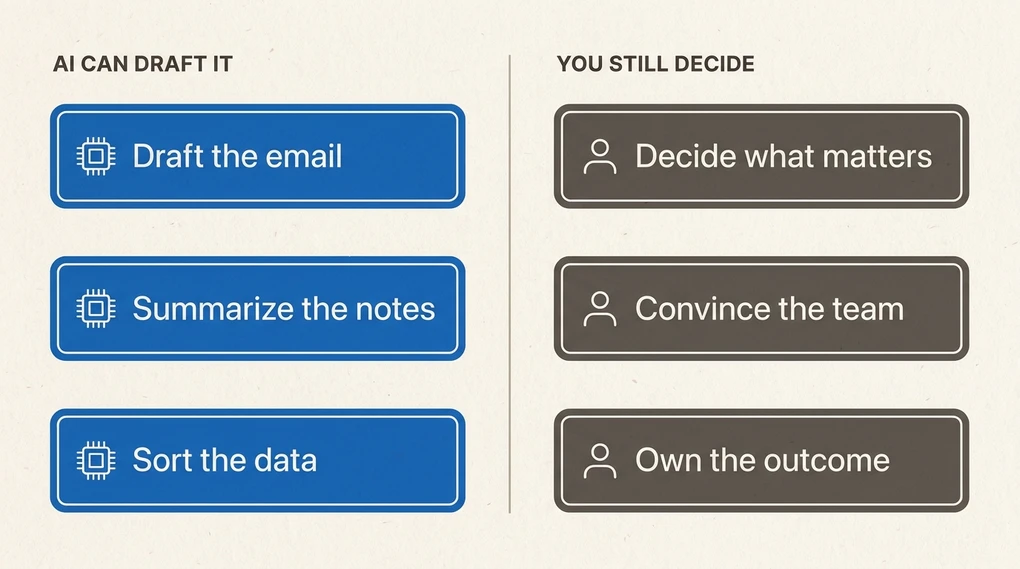
Try it on your own calendar. The tasks most likely to be automated are the repetitive, rule-based ones and the ones that produce a first draft: meeting notes, status updates, routine research, standard emails. The parts that hold up better involve deciding, persuading, taking responsibility, and knowing when the output is wrong. We’ve looked at what AI actually can’t do in its own article, including why the usual list of irreplaceable human skills gets it half wrong. For what that first-draft handoff looks like in practice, there’s how AI saves time at work.
Doesn’t new technology create jobs too?
Historically, new technology has created more work than it destroyed, and by a wide margin. The Goldman report cites work by the economist David Autor finding that 60% of today’s workers are employed in occupations that didn’t exist in 1940. On Goldman’s reading, that means more than 85% of employment growth over the last eighty years came from jobs technology invented.
That’s real, and it’s the strongest argument against panic. It’s also not a promise. It says nothing about how long the gap between the old job and the new one lasts, or who absorbs the cost while it’s open. “In the long run, new jobs appear” is cold comfort to someone whose role is cut this year.
What don’t we know yet about AI and jobs?
Nobody knows the size or the timing of any of this. BCG’s own model excludes inflation, geopolitics, and any AI breakthrough beyond today’s systems, and doesn’t try to predict how fast companies will adopt it. The Anthropic researchers note that only a fairly large change would be visible in their data at this point, so smaller effects could be underway unseen.
There’s also a version of this that has nothing to do with what AI can do. Companies decide how to use it. Some will use AI to help people do more, and some will use it as a reason to cut, and those are management choices rather than facts about the technology.
The most useful thing you can do with all this is stop asking a question about the future of the economy and start asking one about your own week. AI can already read, draft, summarize, and answer. How much of what you’re paid for is that?
If the worry underneath this question is bigger than work, our plain-English look at whether AI is safe to use covers the everyday risks that are actually worth your attention.
Keep going: more calm answers to the questions people worry about, in AI safety.
Frequently asked questions
Will AI take my job?
For most people, the more likely outcome is that the job changes rather than disappears. Researchers looking at US employment data have not yet found a systematic rise in unemployment among workers in the most AI-exposed occupations. What forecasters do expect is a large amount of reshaping: BCG's April 2026 model projects that 50% to 55% of US jobs will be reshaped by AI over two to three years, and that 10% to 15% could be eliminated five years out or later. Those are projections, not measurements, and BCG says plainly that its analysis is not an unemployment forecast.
Is AI causing job losses right now?
Not in a way that shows up clearly in the data yet. A March 2026 study by Anthropic researchers compared unemployment among the most and least AI-exposed US occupations, using public US government survey data, and found no systematic increase for the exposed group since late 2022. The one early signal they did find was a slowdown in hiring for workers aged 22 to 25 in exposed occupations, which they describe as barely statistically significant, meaning it's small enough that it could still be noise.
What jobs are most at risk from AI?
The work that today's AI reaches most easily is desk work that is text-based, structured, and rule-following. In the Anthropic study, the most exposed occupations were computer programmers, customer service representatives, and data entry keyers. One caveat: the study's measure is built from how people use Anthropic's own chatbot, which is used heavily for coding, so programmers may rank first partly because of who its customers are. Either way, this is close to the opposite of the old story about robots and factories: the most exposed workers were, on average, more educated and higher-paid than the least exposed.
What jobs are safest from AI?
Work that needs a body in an unpredictable place, or real-time judgment about people. In the Anthropic data, about 30% of workers were in occupations where AI use barely registered in that data at all, including cooks, motorcycle mechanics, lifeguards, bartenders, and dishwashers. That is a measure of where AI is being used today, not a guarantee about the future.
Does 300 million jobs mean 300 million people will lose their jobs?
No. That figure comes from a Goldman Sachs report published in April 2023, and it says AI could expose the equivalent of 300 million full-time jobs to automation. Exposed means some tasks in those jobs could be automated. The same report concluded that most jobs are only partially exposed and are therefore more likely to be complemented by AI than replaced by it.