AI myths debunked: 7 things people still get wrong
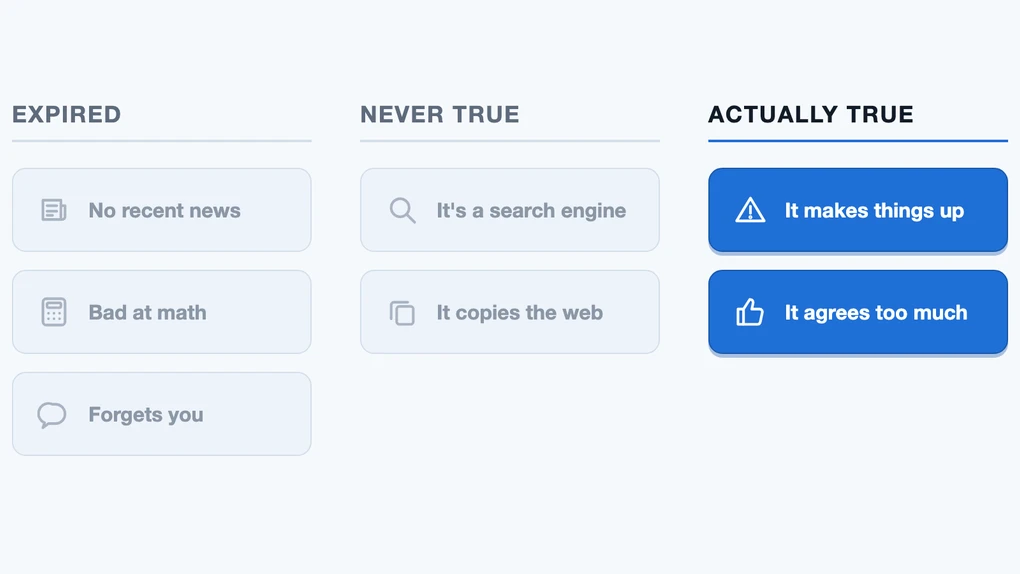
Most lists of AI myths have the same problem: they aged badly. Half the “myths” circulating today were solid facts in 2023 that quietly stopped being true, and a couple of things people wave off as hype are exactly right. Here’s how seven of the most repeated ones hold up.
The short version:
- Three expired. AI can look things up, do arithmetic, and remember you between conversations.
- Two were never true. It isn’t a search engine, and it isn’t copying and pasting from the web.
- Two are real — and both are documented by the companies themselves, not by critics.
Which AI myths are out of date?
The expired myths are the ones about what AI can’t do. Chatbots got new abilities bolted on over the past three years, and the warnings written before that never got updated.

“It doesn’t know anything recent”
This one had a good run. Every AI model has a knowledge cutoff, a date where the text it learned from stops, and for a long time that was a hard wall. Ask about last week’s news and you’d get a polite apology.
Then these assistants learned to search. OpenAI’s help pages now say search tools are “enabled for all models by default”, so ChatGPT can go read current pages and quote them back to you with links. The same page adds that what you get depends on your plan, and it doesn’t spell out which plans get what.
The practical bit: look for the links. If the answer cites sources you can click, it went and looked. If there are no links, you’re getting the model’s memory of its training text, and that’s where a stale answer comes from. Same question, two very different reliability levels, and nothing on screen announces which one you got.
“It can’t do math”
It used to be genuinely bad at arithmetic, and for a funny reason. A model that predicts text one word at a time is guessing what a plausible answer looks like, and 847 × 23 doesn’t have a plausible-looking answer. It has a correct one.
The fix wasn’t to make the model better at sums. It was to hand it a calculator. Assistants now write and run small programs to work things out, which OpenAI lists as code interpreter or data analysis. The math gets done by actual code, not by guessing.
One catch: it doesn’t always reach for the calculator. A sum that looks easy often gets answered the old unreliable way, straight from the model, and there’s no link on screen to tell you which happened. If the number matters, ask it to work the answer out with code and check that a code block actually appears.
“It forgets you the moment you close the tab”
Not anymore. ChatGPT has a memory feature that carries details from past chats into new ones, so you stop re-explaining that you’re vegetarian or that you write in British English. You’ll find the switch under Settings, then Personalization, then Memory. We walk through that screen, and what it now stores, in what ChatGPT remembers about you.
This is the myth we’d most like people to stop repeating, because it cuts both ways. Memory is convenient and it’s also the thing that quietly builds a profile of you. Two details from OpenAI’s own memory FAQ deserve a closer look. The summary page that shows what ChatGPT remembers “will not include everything that ChatGPT remembers based on your chats.” And if you turn memory off and later turn it back on, it can rebuild memories from chats still sitting in your history.
If you want a conversation that leaves no trace in memory, that’s what Temporary Chats are for. They don’t use existing memories and don’t create new ones.
Which AI myths were never true?
The permanent myths are the ones about where the words come from. Both of these were wrong in 2023 and are still wrong now, which is what makes them durable.

“It’s basically a search engine”
No, and the gap is bigger than it sounds. A search engine finds pages somebody already wrote and hands you the list. A chatbot writes you a brand-new answer, one word at a time, based on patterns it picked up from an enormous pile of text.
This holds even now that it can search. When ChatGPT looks something up, it reads a few pages and then still writes the answer itself. Nothing gets copied out. That’s why two people asking the identical question get differently worded replies, and why a chatbot can hand you a confident answer about a page that says the opposite.
Treating it like a search engine is what leads people to trust the output the way they’d trust a link. A link either goes to the source or it doesn’t. A generated sentence is always somewhere in between.
“It’s just copying and pasting from the web”
It isn’t, and this one is worth getting right because people use it to dismiss the whole technology.
During training, a model reads an enormous amount of text and adjusts billions of internal settings based on it. What it keeps are those settings — the patterns. The original text isn’t stored in there for it to fish out later. That’s why a large language model can write you a limerick about your specific cat’s specific habit of sitting in the sink. Nobody wrote that limerick for it to copy.
One thing to keep separate, though: “it doesn’t copy” is a claim about how the software works, not a verdict on whether training on other people’s writing was fair. That argument is real, it’s in the courts, and it doesn’t depend on this myth being true.
Which AI “myths” are actually true?
Two of the seven are true, and you don’t have to take our word for either. Both come from the companies that build these tools.
“It makes things up”
True, and OpenAI says so in plain language. Its help pages use the word hallucination and list the shapes it takes: wrong dates and definitions, fabricated quotes, and citations to studies that don’t exist. The company’s own advice is to treat ChatGPT as a first draft and check anything that matters.
Here’s the update most people missed. Web search made this less frequent, and a lot of readers filed that away as “solved.” It isn’t. OpenAI still warns, separately and on the same page, that “confidence isn’t reliability” — the model can sound completely certain while being wrong.
The uncomfortable part is that a made-up answer looks exactly like a correct one. There’s no wobble in the voice. Trained professionals have gone along with confident wrong answers in a controlled study, so “I’d notice” is not a plan.
There’s a reason it guesses instead of holding back, and it’s stranger than most people expect: the tests used to rank these models award more points for a lucky guess than for “I don’t know”. We unpack that, and what actually reduces it, in why ChatGPT makes things up.
“It just tells you what you want to hear”
Also true, and it has a name: sycophancy. It’s not a personality quirk, it’s a side effect of how these assistants get tuned. Part of the training uses thumbs-up and thumbs-down feedback from real users, and people reliably reward answers that agree with them.
In April 2025 this got bad enough that OpenAI rolled back a GPT-4o update to ChatGPT and published an explanation. The company said it had “focused too much on short-term feedback” and that the model “skewed towards responses that were overly supportive but disingenuous.”

That was one bad update, and it got fixed. The pull toward agreement didn’t go away, because the incentive that created it didn’t. So if you ask “is my plan any good?” you’re asking a question the tool is tilted to answer yes to. Ask “what’s wrong with this plan?” instead. You’ll get a different, more useful answer from the same model.
Why do these myths stick around?
Because nobody goes back and edits the article. Search for AI myths and a lot of what comes back was written in 2023 or earlier, before ChatGPT could search the web, run code, or remember anything about you — and plenty of it carries no date on the page at all. Those pieces still rank. They’re still confidently describing limits that lifted years ago.
So check the date on any myth list before you trust it. Including this one.
The other reason is that a myth list is comfortable. “AI can’t really think” is soothing. “AI will agree with your bad idea in a warm and articulate way” is not, and it’s the one that’ll actually cost you something.
A couple of the classics we’ve handled elsewhere and won’t repeat here: whether AI is coming for your job (the honest answer is about tasks, not job titles), and whether AI and machine learning are the same thing (they’re not, and the difference is easier than it looks).
If you want the practical follow-up to all this, our guide to using AI safely covers what to share, what to hold back, and how to sanity-check an answer before you act on it. The rest of the AI safety section picks up from there.
About the pictures: the three illustrations in this article were generated with AI — two with ChatGPT, one with Gemini. The diagram at the top was built by hand. None of them shows a real person, place, or event. It seemed fair to say so in a piece about being honest with AI.
Frequently asked questions
Does ChatGPT know about recent events?
Usually, yes. Every model has a knowledge cutoff — a date its training text stops at — but that stopped being the whole story once these assistants got the ability to search the web. OpenAI's help pages say search tools are enabled for all models by default, while noting on the same page that what you get depends on your plan. You can tell it searched when the answer comes back with links. If there are no links, you're reading the model's memory of its training text, and that's where old information shows up.
Is ChatGPT a search engine?
No, and the difference matters even now that it can search. A search engine finds pages that already exist and hands you the list. ChatGPT writes you a fresh answer one word at a time, based on patterns it learned from a huge amount of text. When it does search, it reads some pages and then still writes the answer itself. So the sentence you get back was composed for you, not retrieved from anywhere. That's why two people asking the same question get different wording.
Are AI hallucinations still a problem in 2026?
Yes, and OpenAI says so in its own help pages. It calls them hallucinations and lists the usual shapes: wrong dates and definitions, invented quotes, and citations to studies that don't exist. The company's own advice is to treat ChatGPT as a first draft and verify anything that matters. Web search made this less frequent but didn't end it — OpenAI still warns separately that the model can sound confident while being wrong.
Why does ChatGPT always agree with me?
Because agreeing gets rewarded. These assistants are partly tuned using thumbs-up and thumbs-down feedback from users, and people tend to reward answers that flatter them. OpenAI hit this hard enough in April 2025 that it pulled a GPT-4o update and published an explanation, saying it had focused too much on short-term feedback and the model had skewed toward responses that were supportive but disingenuous. The behavior has a name: sycophancy.